Academic work

Publications

Work on wearable interaction, accessible apparel, and inclusive participation.

Academic publications

Human–Computer Interaction

A Pneumatic, Adjustable-Buoyancy Wearable for Prenatal Water Activities

CHI Extended Abstracts · 2026

Expand detailsCollapse details

Y Qin, Z Ran, X Li, M Fan

Proceedings of the Extended Abstracts of the 2026 CHI Conference on Human Factors in Computing Systems

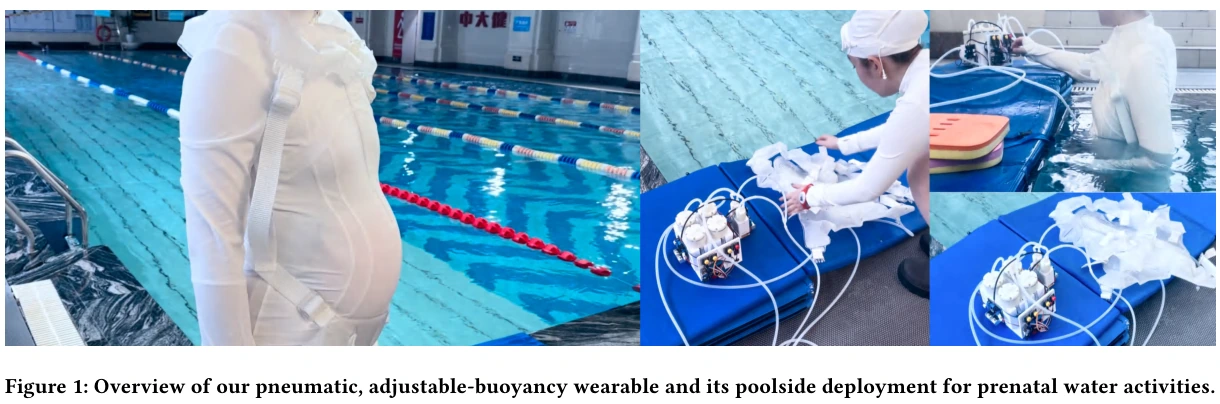
Overview of the pneumatic, adjustable-buoyancy wearable and its poolside deployment for prenatal water activities.
Fig. 1 · Overview of the pneumatic, adjustable-buoyancy wearable and its poolside deployment for prenatal water activities.

Abstract

Original abstract · Published PDF · p. 1

Swimming during pregnancy is widely seen as health-promoting, but pregnancy-related bodily changes can increase imbalance risk and safety anxiety in public pools, limiting participation. To reduce these barriers and enable flexible "swim-or-rest" engagement, we propose an adjustable-buoyancy wearable using distributed air and water bladders across the torso to create localized lift and counterweighting. This supports stable transitions among three postures: sitting-in-water, head-up breaststroke, and supine floating. Based on interviews and co-design workshops (N = 22), we defined design goals and built a prototype, then ran an in situ feasibility study in a public pool with three participants, assessing perceived effort, trunk support, subjective safety, and movement constraints. Results show that the prototype offers nonrestrictive support: it reduces abdominal sinking without compressing the torso, preserves limb mobility, lowers perceived risk, and improves overall experience. We contribute reusable mechanisms and design implications for inclusive aquatic wearables and soft interactive systems.

2026Conference / Extended Abstract

A Pneumatic, Adjustable-Buoyancy Wearable for Water Activities
Y Qin, Z Ran, X Li, M Fan

Proceedings of the Extended Abstracts of the 2026 CHI Conference on Human Factors in Computing Systems .

Overview of the pneumatic, adjustable-buoyancy wearable and its poolside deployment for prenatal water activities.
Fig. 1 · Overview of the pneumatic, adjustable-buoyancy wearable and its poolside deployment for prenatal water activities.

When Books Start Talking: Reimagining Libraries through Socially Interactive Book Agents

ICHEC · 2026 · Artwork / Art Gallery

Conditionally Accepted

Expand detailsCollapse details

Hongsen Chen, Y Qin

International Conference on Human-Engaged Computing (ICHEC 2026)

· Submission 335

2026Artwork / Art Gallery

When Books Start Talking: Reimagining Libraries through Socially Interactive Book Agents

Hongsen Chen, Y Qin

International Conference on Human-Engaged Computing (ICHEC 2026)

Conditionally Accepted · · Submission 335

Fashion & Textile Research

Shapewear design based on elderly female body model

Journal of Textile Research · 2026

Expand detailsCollapse details

Y Qin, YU Xiaohan, ZHANG Zihan, REN Jinhui

Journal of Textile Research · 47 (8), 198–208

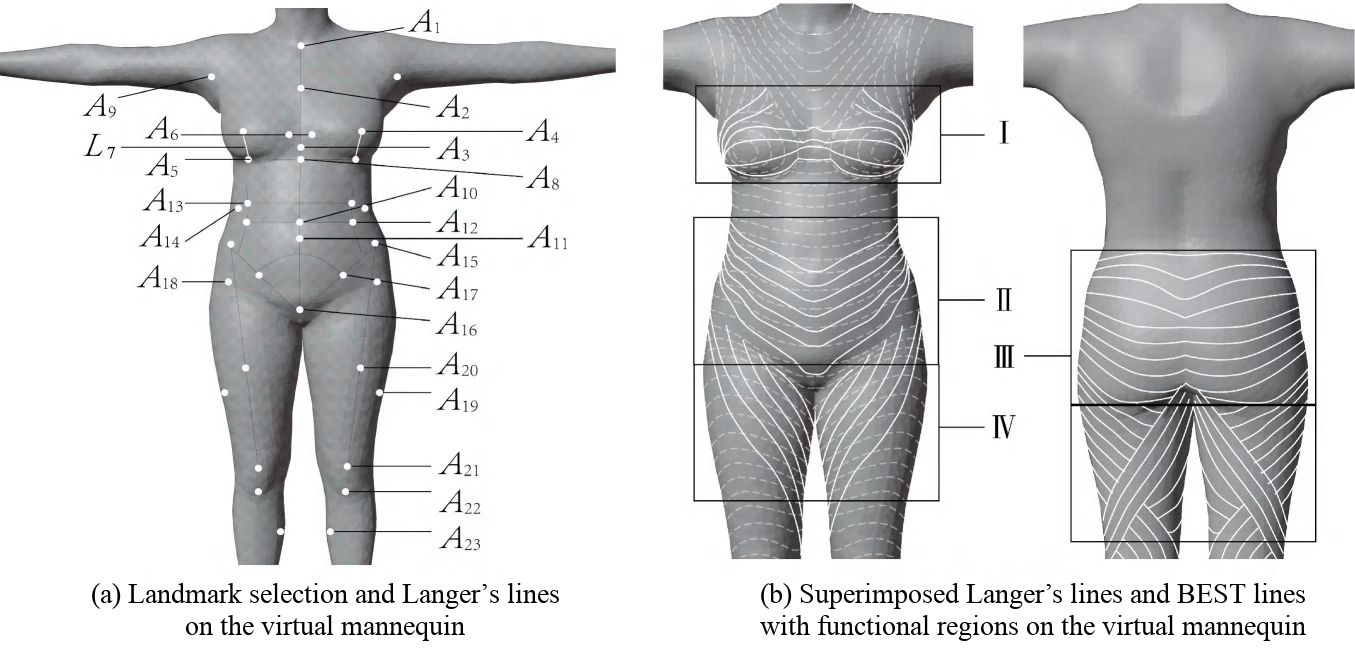
Landmark selection and skin tension lines on the virtual mannequin: (a) landmarks and Langer’s lines; (b) Langer’s and BEST lines with functional regions.
Fig. 2 · Landmark selection and skin tension lines on the virtual mannequin: (a) landmarks and Langer’s lines; (b) Langer’s and BEST lines with functional regions.Website-translated figure

Abstract

Website translation · Author-held proof · 25 July 2026 · p. 1

This study investigates adjustable shapewear construction based on the mechanical characteristics of skin, addressing typical older-female body features—including breast sagging, abdominal protrusion, buttock descent, and thigh laxity—and the difficulty of existing shapewear in accommodating localized soft-tissue laxity and body-shape differences. Anthropometric data were collected from 113 women aged 60–70, with supplementary measurements of 18 participants, to construct and optimize a representative three-dimensional virtual body model. Langer’s lines and Biodynamic Excisional Skin Tension Lines (BEST lines) were combined to define skin-tension zones at the breasts, waist and abdomen, buttocks, and legs. Adjustable strategies for breast support, waist and abdominal containment, buttock lifting, and leg support were proposed, and three prototypes underwent virtual fitting and pressure analysis. Results support differentiated zonal design for older women’s shapewear. Physical tests showed mean pressures of 6.94, 5.94, 3.48, and 3.94 kPa at the lower breast edge, the most protruding abdominal point, the narrowest central waist point, and the lateral waist point, respectively, broadly consistent with virtual analysis. Two participants gave comfort scores of 4.0 and 4.5, indicating that the method can address differentiated needs across these regions and inform body-fitting, zonal, and adjustable construction.

2026Journal Article

Shapewear design based on body model

Y Qin, YU Xiaohan, ZHANG Zihan, REN Jinhui

Journal of Textile Research . 47 (8), 198–208.

Landmark selection and skin tension lines on the virtual mannequin: (a) landmarks and Langer’s lines; (b) Langer’s and BEST lines with functional regions.
Fig. 2 · Landmark selection and skin tension lines on the virtual mannequin: (a) landmarks and Langer’s lines; (b) Langer’s and BEST lines with functional regions.Website-translated figure

Design of Accessible Bibs for Dining by People with Visual Impairments

Journal of Textile Research · 2026

Expand detailsCollapse details

Y Qin, J Li, Z Ji, J Guo

Journal of Textile Research · 47 (3), 247–254

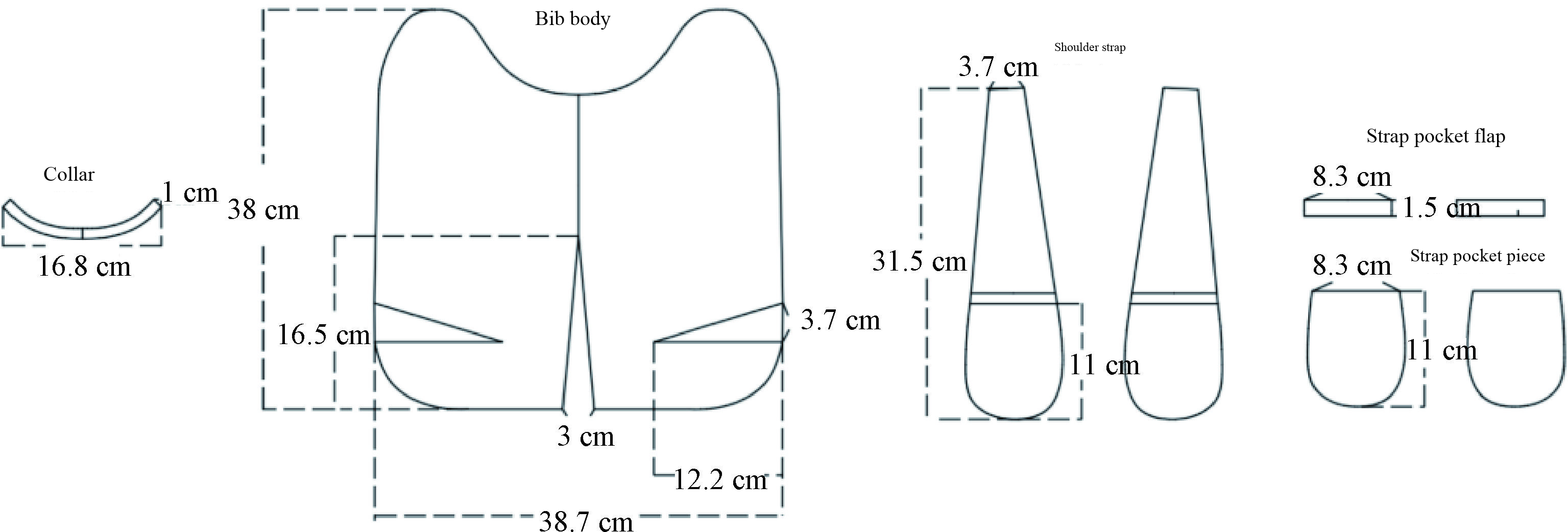
Pattern structure design of the shawl-style accessible bib.
Fig. 5 · Pattern structure design of the shawl-style accessible bib.Website-translated figure

Abstract

Website translation · Published PDF · p. 1

This study examines the needs and design of bibs as dining-assistance clothing accessories for people with visual impairments, addressing difficulties in wearing accessories and insufficient protection. Using mixed methods, it conducted in-depth interviews with 20 visually impaired people, collected 42 valid questionnaires, and completed 18 dining-scenario experiments. Market research identified functional requirements for bibs, which were analyzed using the Kano model. An accessible bib design was then proposed, and CLO 3D was used to simulate virtual fitting and wearing effects to verify its feasibility. Results indicate that dining barriers center on color recognition, stain detection and cleaning, structural ease of use, and personalized expression. Core needs include stain-resistant materials, ergonomic protective structures, convenient donning and doffing solutions, and personalized appearance. The resulting cape-style bib uses upturned edges, achieving a liquid-blocking delay of more than 3 s, improving liquid-guidance efficiency by over 40%, and reducing stain-spill area by 65%. Stability tests show that weights of 50–100 g reduce the bib drop rate by 82.1%–100% compared with no weight, with 80 g being optimal. The findings provide practical guidance for inclusive design of dining-assistance clothing for people with visual impairments.

2026Journal Article

Design of Accessible Bibs for Dining by

Translated title

Y Qin, J Li, Z Ji, J Guo

Journal of Textile Research . 47 (3), 247–254.

Pattern structure design of the shawl-style accessible bib.
Fig. 5 · Pattern structure design of the shawl-style accessible bib.Website-translated figure

Design Requirements for Accessible Dining Apparel for the Visually Impaired

TBIS · 2025

Expand detailsCollapse details

Y Qin, ZR Ji, JX Li, JY Lin, KY Yu, J Guo

Textile Bioengineering and Informatics Symposium Proceedings · TBIS 2, 1198–1205

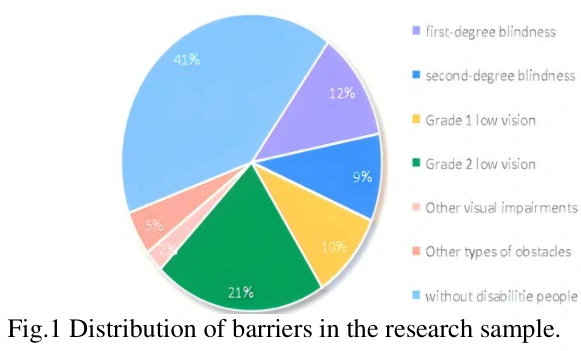
Distribution of barriers in the research sample.
Fig. 1 · Distribution of barriers in the research sample.

Abstract

Original abstract · Published PDF · p. 1

This study addresses the lack of targeted research on accessible dining clothing for the visually impaired. In response to this gap, we conducted a mixed-methods study involving in-depth interviews, questionnaire surveys, and real-world experiments with visually impaired participants to examine their specific clothing needs during meals. The findings reveal key challenges in color recognition, stain detection, garment cleaning, functional design, and personalization. Based on the results, we identify core design requirements for accessible bibs, including stain-resistant materials, ergonomic structures, and aesthetic considerations tailored to user preferences. This paper contributes empirical insights and practical guidelines to support inclusive design in sustainable fashion, offering a theoretical foundation for the future development of accessible clothing for the visually impaired.

2025Conference Proceeding

Design Requirements for Accessible Dining Apparel for the

Y Qin, ZR Ji, JX Li, JY Lin, KY Yu, J Guo

Textile Bioengineering and Informatics Symposium Proceedings . TBIS 2, 1198–1205.

Distribution of barriers in the research sample.
Fig. 1 · Distribution of barriers in the research sample.

Design Guidelines for Accessible Dining Apparel for the Visually Impaired: Toward Inclusive and Sustainable Fashion

Journal of Fiber Bioengineering and Informatics · 2025

Expand detailsCollapse details

Y Qin, ZR Ji, JX Li, JY Lin, KY Yu, J Guo

Journal of Fiber Bioengineering and Informatics · 18 (4), 291–305

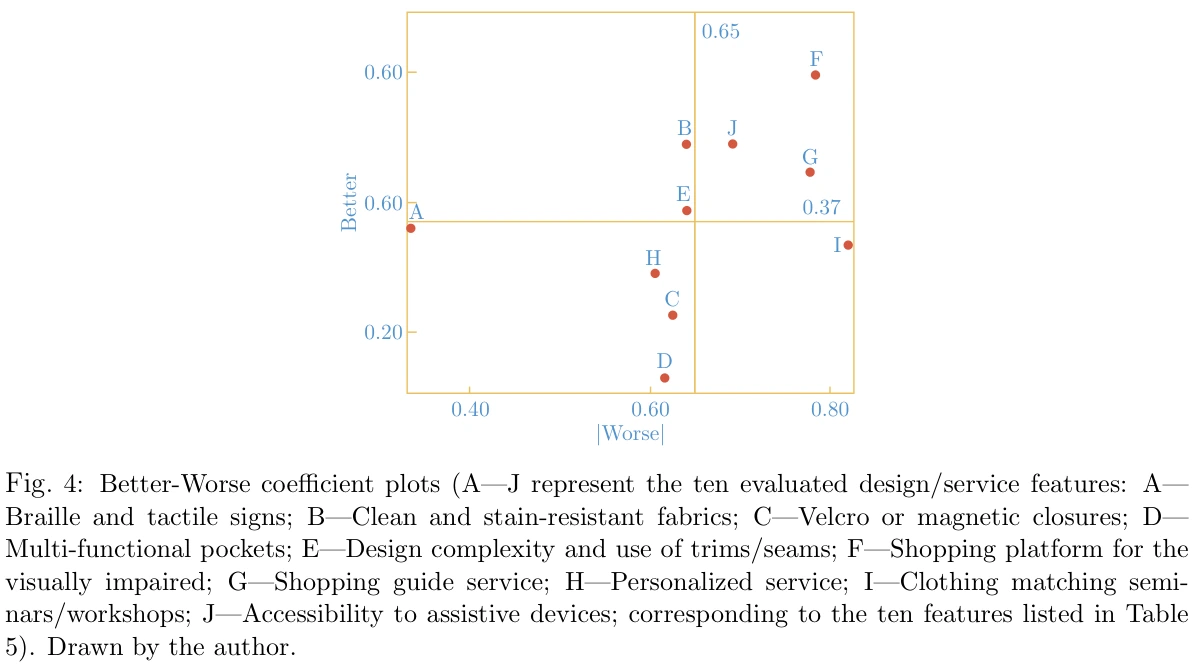
Better–Worse coefficient plots; A–J identify the ten evaluated design and service features.
Fig. 4 · Better–Worse coefficient plots; A–J identify the ten evaluated design and service features. A: Braille and tactile signs; B: clean, stain-resistant fabrics; C: Velcro or magnetic closures; D: multifunctional pockets; E: design complexity and trims/seams; F: shopping platform for visually impaired users; G: shopping guidance; H: personalized service; I: clothing-matching workshops; J: access to assistive devices. Corresponds to Table 5; drawn by the author.

Abstract

Original abstract · Published PDF · p. 1

This study is to address the lack of targeted research on accessible clothing for the visually impaired. In response to this gap, we conducted a mixed-methods study involving in-depth interviews, questionnaire surveys, real-world experiments with visually impaired participants to examine their specific clothing needs during meals, and Market investigation. Based on the analysis of over 70 sample cases, the main challenges were identified as color recognition, stain detection, garment cleaning, functional design, and personalization. Meanwhile, we identify core design requirements for accessible bibs, including stain-resistant materials, ergonomic structures, and aesthetic considerations tailored to users preferences. This paper contributes empirical insights and practical guidelines to support inclusive design in sustainable fashion, offering a theoretical foundation for future development of accessible clothing for the visually impaired.

2025Journal Article

Design Guidelines for Accessible Dining Apparel for the : Toward Inclusive and Sustainable Fashion

Y Qin, ZR Ji, JX Li, JY Lin, KY Yu, J Guo

Journal of Fiber Bioengineering and Informatics . 18 (4), 291–305.

Better–Worse coefficient plots; A–J identify the ten evaluated design and service features.
Fig. 4 · Better–Worse coefficient plots; A–J identify the ten evaluated design and service features. A: Braille and tactile signs; B: clean, stain-resistant fabrics; C: Velcro or magnetic closures; D: multifunctional pockets; E: design complexity and trims/seams; F: shopping platform for visually impaired users; G: shopping guidance; H: personalized service; I: clothing-matching workshops; J: access to assistive devices. Corresponds to Table 5; drawn by the author.

Patents